
Catch the fake interview before it reaches your report
Data quality assurance for surveys means proving, record by record, that an interview happened where and when it should, with the right person, and that the answers were not invented or copied. Bharat Survey builds this into fieldwork: back check forms, location verification, duration and pattern flags, a risk-scored review queue and an audit trail of every correction. Research agencies, NGOs and departments use it on their own projects through our software, or hand us the quality control of data another team collected.
- Location verified against the assigned area
- Short, rushed or duplicate interviews flagged
- Supervisor back-checks with a separate form
- Every edit and approval logged
- In areaInside approx. boundary
- Accuracy±12 m
- Time09:42 · fresh fix
- Mock GPSNot detected
- Interview length11 min
Why this exists
Validation while the interview happens
Skip logic, range limits and consistency rules stop impossible answers at the doorstep: a 12-year-old head of household, 40 hours of work a day, or an income module skipped when it should run.
- Range and logic checks
- Required fields enforced
- Comes regularly
- Comes sometimes
- Rarely / never
- Don't know
Location and timing evidence
Each record carries GPS location compared with the assigned village or ward, labelled in-area, near boundary, outside, poor signal or mock location. Start time, end time and duration are captured automatically.
- Five location states
- Mock GPS flagged
- Duration recorded
- In areaInside approx. boundary
- Accuracy±12 m
- Time09:42 · fresh fix
- Mock GPSNot detected
- Interview length11 min
Pattern and risk scoring
Records are scored for risk from signals such as location state, very short duration and unusual submission patterns. High-risk records go to a review queue, not the dataset, and supervisors look across an enumerator's records for copied answers.
- Risk-scored review queue
- Enumerator-level patterns
Back-checks by supervisors
Supervisors re-visit or call a sample of respondents with a short back-check form: did the interview happen, how long did it take, and do a few key answers match. Mismatch rates are reported per enumerator.
- Random plus targeted samples
- Mismatch rate per enumerator
- Complete
- Partial
- Declined
- No contact
- Home locked
- Revisit
| Signal | What it may mean | Check |
|---|---|---|
| Location outside assigned area | Interview not done at the doorstep | Location state on record, supervisor review |
| Mock location detected | GPS spoofing app in use | Flag and block from approval |
| Very short duration | Questions skipped or answers invented | Duration threshold per form |
| Many records from one spot in minutes | Forms filled at one place | Supervisor review of submission times and places |
| Same answers across records | Copied or straight-lined responses | Supervisor review of the enumerator's records |
| Back-check mismatch | Respondent not interviewed | Mismatch rate by enumerator |
Location verification uses approximate village or ward boundaries. A flag is a reason to review, not proof of fraud.
A clean dataset raises a fair question: what was cleaned, by whom, and why? Our audit trail answers it. Every correction keeps the original value, the new value, the user and the time. Approvals, rejections, back-check results and exports are logged. Form versions are tracked, so a change to a question mid-fieldwork is visible in the data.
Why reviewers care
Donors, evaluation committees, journal reviewers and procurement auditors increasingly ask for evidence behind survey numbers. An audit trail lets you show that rejected interviews were rejected for stated reasons and that no one quietly edited results after fieldwork.
Logged events
- Record submitted with evidence
- Flags raised and cleared
- Corrections with before and after
- Back-check results
- Approvals and rejections
- Data exports
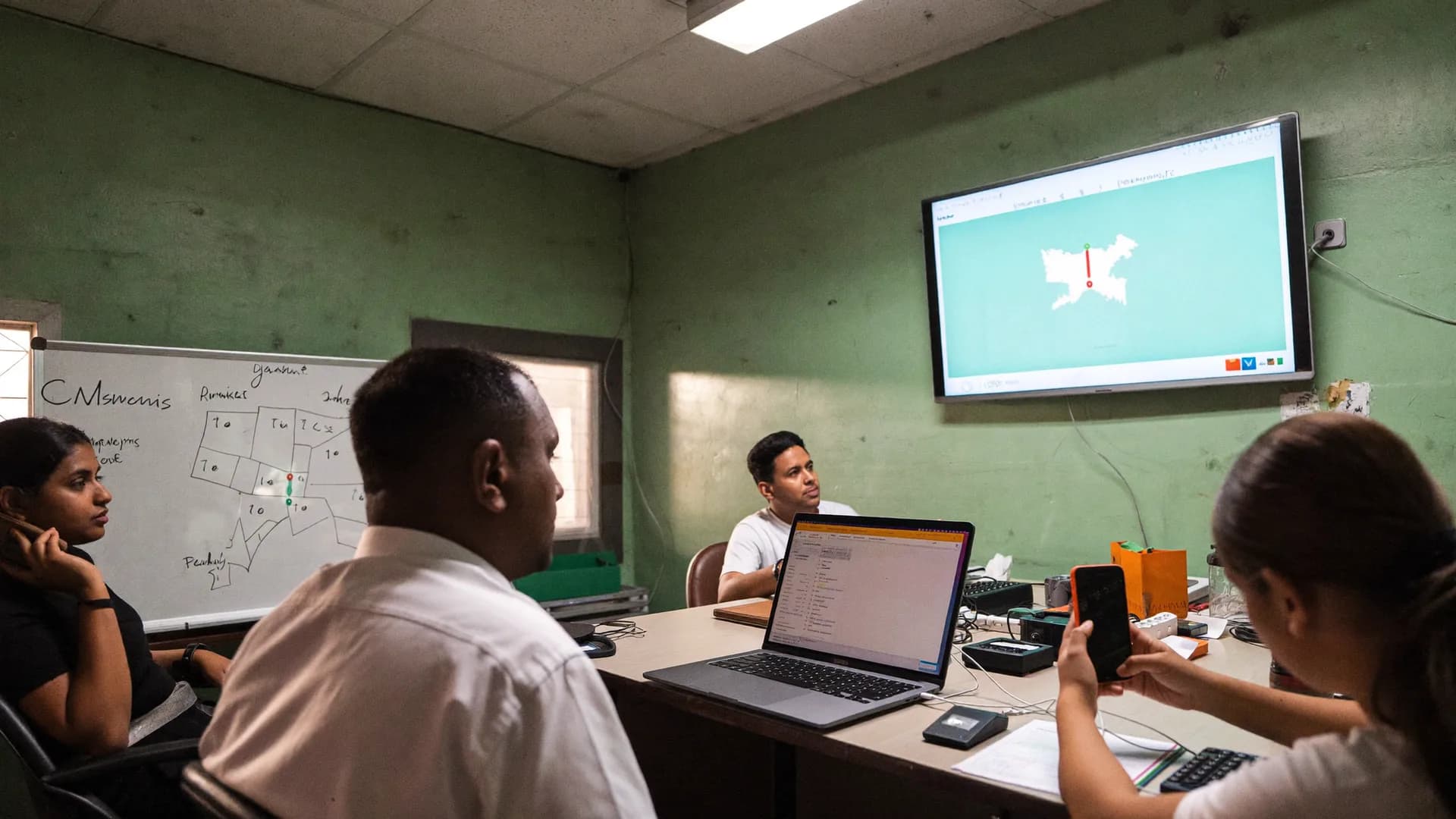
For data collected by your own team or another agency, we can run the quality control independently.
Quality plan
Daily monitoring
Back-check rounds
Cleaning and handover
Geo-tagged only
Common in survey tools
- Records where the phone was
- No comparison with assigned area
- Mock GPS often unnoticed
- No link to back-check results
- Reviewer must spot problems manually
Verified
Bharat Survey approach
- Location compared with assigned area
- Mock location flagged
- Duration and pattern checks
- Back-check results on the record
- Unverified records never auto-approved
Not the right fit if
- Exact household-level geofencing (boundaries are approximate)
- Proving fraud without human review
- Fixing a questionnaire that measures the wrong thing
- Quality control after data was collected on paper with no evidence
A good fit if
- Large field teams across many districts
- Projects facing external review or audit
- Agencies wanting enumerator-level quality data
- Studies with volunteer or partner enumerators
All features
Everything in the Bharat Survey platform.
Learn moreSurvey app development
Custom workflows on the core app.
Learn moreWhatsApp and SMS surveys
Message-based surveys.
Learn moreCustomer feedback software
Feedback collection for businesses.
Learn moreField inspection app
Inspections with photo and location evidence.
Learn moreStraight answers to the questions people ask most about this topic.
What share of interviews should be back-checked?
It depends on team size, experience and the stakes of the study. Many research teams back-check a fixed random share plus extra checks on flagged records and new enumerators. We help set the share in the quality plan and report back-check coverage and mismatch rates, so reviewers can judge whether it was enough.
Can GPS verification be fooled?
Mock location apps can fake GPS. The app detects mock location where Android exposes it and flags the record. Because boundaries are approximate, location is one signal among several; duration, patterns and back-checks together make fabrication much harder to hide.
Do flagged records get deleted?
No. Flagged records stay in the review queue with their evidence. A supervisor approves, corrects with a logged reason, or rejects them. Rejected records remain visible in the audit trail and can be reported in the methods annex.
Can you check data collected in another tool?
We can run cleaning, consistency checks and independent back-checks on data from another tool if respondent contact details and consent for re-contact exist. Location and duration checks need that evidence to have been captured in the original tool.
Tell us the study, team size and tool you use. We will suggest a quality plan and how to run it.