
Polling-day interviews with a method you can publish next to the numbers
Bharat Survey is an exit poll survey agency in India for newsrooms, research institutes and campaigns that want polling-day data they can defend. We draw a random sample of polling stations, train interviewers to approach every nth voter, record the vote privately on an offline phone, and hold all results until the Election Commission's Section 126A window closes. Survey estimates carry a margin of error; they are not a prediction of the official result.
- Random polling-station sample, not convenience spots
- Private vote entry on the interviewer's phone
- Hourly refusal and quota tracking
- Release only after the notified embargo
- Complete
- Partial
- Declined
- No contact
- Home locked
- Revisit
- Comes regularly
- Comes sometimes
- Rarely / never
- Don't know
An exit poll measures how a sample of voters say they voted, minutes after voting. It is good at vote share and at explaining who voted how. It is weakest when vote share is converted into seats.
The sampling unit is the polling station. We list stations in the constituencies being covered from public Election Commission data, stratify them by region and past turnout, and select stations at random. Interviewers do not choose where to stand or whom to approach: they count voters leaving and approach every nth one, recording refusals as carefully as interviews.
The questionnaire is short, usually under five minutes. The voter enters their choice privately on the phone screen, then answers a few profile questions such as age band, education, occupation and when they decided. Each record carries station code, time and GPS, so a record from the wrong place is visible immediately.
The legal window
Section 126A of the Representation of the People Act, 1951 bars conducting and publishing exit poll results in any form during the period the Election Commission notifies, which for multi-phase elections runs until the last phase closes. We plan release timing against that notification and hold data on our systems until it lapses.
Each exit poll record
- Station code and constituency
- Interviewer ID
- Time and GPS point
- Privately entered vote
- Age band, gender, education
- Decision timing
- Refusal tally for the hour
- 01
Station sample and deployment plan
Stations are drawn at random within strata. Each gets a trained interviewer and a backup, with travel planned so teams are in place before polling starts.Weeks beforeRam Kumar · shift on26.8467 N · 80.9462 E · ±12 m14Received12Accepted1Review1Outside - 02
Interviewer training and rehearsal
Training covers the selection interval, neutral introductions, keeping a legal distance from the station as directed, private vote entry and refusal logging.Days before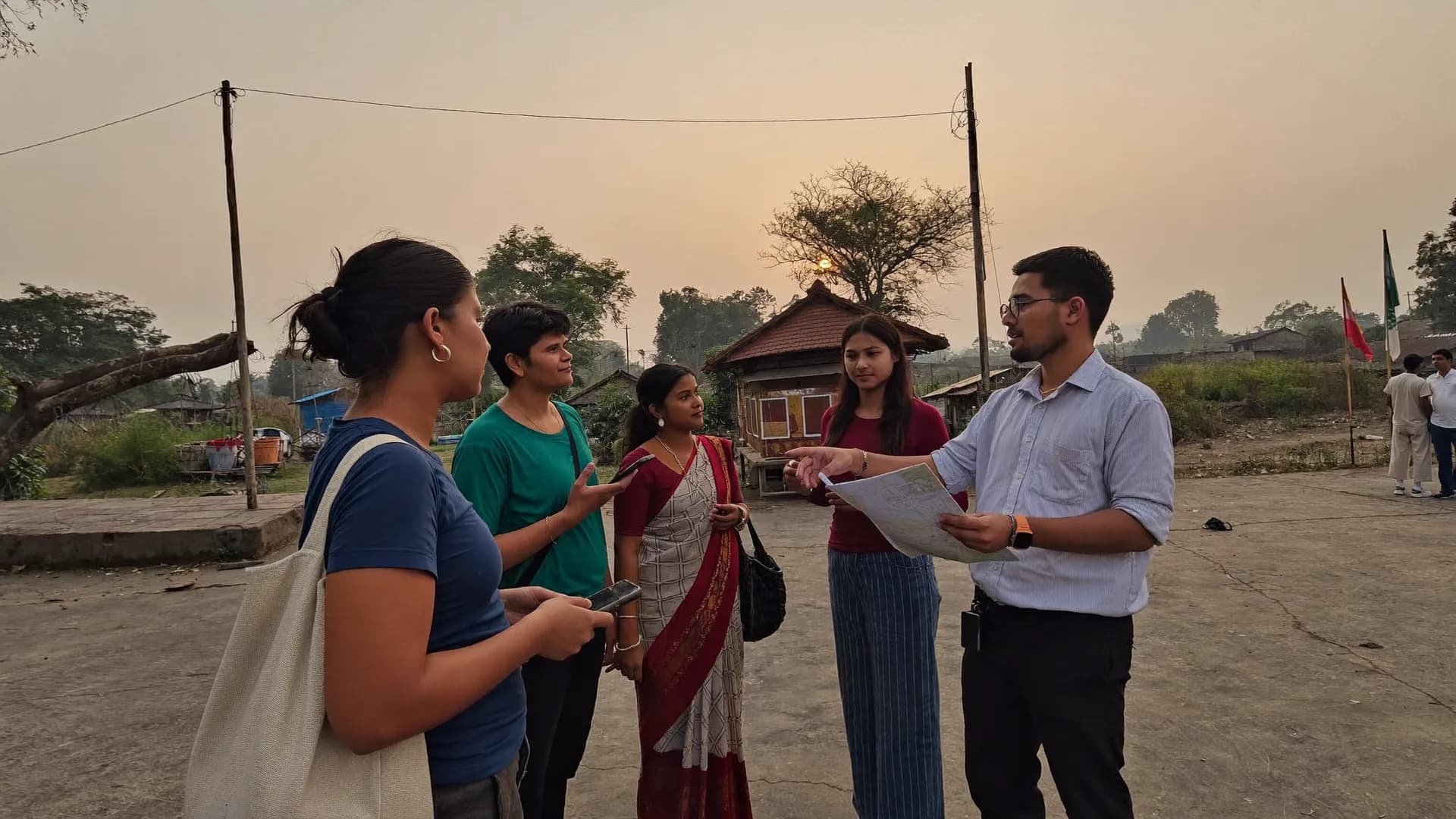
- 03
Interviews through the day
Interviewers work in time blocks so morning and evening voters are both covered. Phones work offline and sync when network allows.Polling daySurvey 3/6 · AmenitiesOfflineHow is drinking water in your area?- Comes regularly
- Comes sometimes
- Rarely / never
- Don't know
✓ Section saved on phone · autosaveBackNext - 04
Live quality checks
Supervisors watch hourly counts, refusals and GPS. A station with too few interviews or odd patterns is flagged and followed up the same day.Polling dayLocation evidenceSurvey #BS-0412- In areaInside approx. boundary
- Accuracy±12 m
- Time09:42 · fresh fix
- Mock GPSNot detected
- Interview length11 min
Added to accepted count - 05
Weighting and embargoed release
Data is weighted to station-level turnout and demographic benchmarks. Results are prepared under embargo and released only after the notified window.After polls close3,000Target homes2,184Visits1,962Completed1,871AcceptedDaily accepted surveysLast 12 days
- Comes regularly
- Comes sometimes
- Rarely / never
- Don't know
- In areaInside approx. boundary
- Accuracy±12 m
- Time09:42 · fresh fix
- Mock GPSNot detected
- Interview length11 min
Our position on exit polls
Both are legitimate. They answer slightly different questions and should be labelled accurately when published.
| Exit poll | Post-poll survey | |
|---|---|---|
| Where and when | Outside polling stations, on polling day | At home, within a few days of voting |
| Sample | Random polling stations, every nth voter | Households in sampled polling-station areas |
| Questionnaire | Very short, under five minutes | Longer, on reasons and issues |
| Strongest for | Vote share estimates | Voter motivations and group analysis |
| Main weakness | Refusals and station selection | Memory and social pressure |
| Release | After the Section 126A window ends | Also follows ECI directions |
Once results are declared, the survey data becomes a tool for understanding rather than forecasting.
Who voted for whom
When voters decided
What mattered most
Where the estimate missed
Leadership and candidate effects
Clean dataset and codebook
Method questions
- How were stations selected?
- What was the selection interval?
- How many refusals were recorded?
- What were the weights based on?
- What is the margin on vote share?
Evidence questions
- Can we see station-wise interview counts?
- Is every record time and GPS stamped?
- Which stations were flagged and why?
- Will raw data be shared after release?
- Who wrote the method note?
Not the right fit if
- You want any result shared before the embargo ends
- You want seat numbers without a disclosed model
- You want interviewers placed only in friendly areas
- You want a guaranteed accurate exit poll
A good fit if
- Newsrooms that publish a method note
- Research institutes studying voter behaviour
- Campaigns wanting a private, post-release analysis
- Clients who want station-level evidence
Exit poll methodology guide
How exit polls are conducted in India, step by step.
Learn moreOpinion poll survey
Pre-election polls before the silence period.
Learn morePre-poll survey
Tracking rounds during the campaign.
Learn moreMedia poll partner
Field and data partner for newsrooms.
Learn morePolitical survey solutions
All political research services.
Learn moreराजनीतिक सर्वे
Political surveys in Hindi.
Learn moreStraight answers to the questions people ask most about this topic.
When can exit poll results be published in India?
Only after the period notified by the Election Commission under Section 126A ends. For multi-phase elections this is usually after the last phase of polling closes, so results from early phases are held until then. We plan timelines and data access around that notification.
How many polling stations does an exit poll need?
It depends on how many constituencies are covered and whether you need region-wise or seat-wise figures. More stations with fewer interviews each generally beat a few stations with many interviews, because voters at one station tend to be alike. We share the design before quoting.
How do you stop interviewers picking friendly voters?
They follow a fixed interval, approaching every nth voter who leaves, and log each refusal. Supervisors watch hourly counts and GPS, and a station with unusual patterns is checked the same day.
Do you convert vote share into seats?
On request, using a disclosed model, and clearly labelled as a model with a range. Vote share is what the survey measures; seat conversion adds assumptions about how votes are spread across constituencies.
Tell us the election, the constituencies and how you plan to use the results. We will reply with a station sample design and release plan.