

Booth samples, voter interviews, legal timing and honest error margins
How are exit polls conducted in India? Researchers pick a random sample of polling stations, place trained interviewers outside them on polling day, and ask departing voters a short, anonymous questionnaire. The answers are weighted and converted into vote shares and seat ranges. This guide is for newsrooms, researchers and campaign analysts who want to understand the method, the law and the limits.
- Station sampling, not voter lists
- Section 126A decides when results can be released
- Vote share to seats is the riskiest step
- No exit poll is a guaranteed result
- Comes regularly
- Comes sometimes
- Rarely / never
- Don't know
An exit poll is a survey of people who have just voted, conducted outside the polling station on the day of voting. Because it asks about a vote already cast, it avoids the undecided-voter problem of pre-poll surveys, but it still depends on who agrees to answer and how the sample of stations was drawn.
The unit that gets sampled is the polling station, because India has no public list of who voted before counting day and because researchers should never work from personal voter data. A team selects constituencies, then stations inside each one, then voters at each station using a fixed interval, such as every fifth person who walks out. That interval stops interviewers from picking friendly or approachable faces.
The questionnaire is short. A typical instrument records the vote on a secret slip or a private screen, then asks a handful of profile questions: age band, gender, education, occupation, the issue that mattered most and when the voter decided. Longer forms raise refusals, and refusals are not random.
Exit poll vs post-poll survey
Some agencies interview voters at home a day or two after polling instead of at the gate. That post-poll survey allows a longer questionnaire and better household selection, but memory and social pressure creep in. Both are legitimate when the method is disclosed. The label on the broadcast should match what was actually done.
Typical exit poll record
- Station code and constituency
- Interviewer ID and timestamp
- GPS point outside the station
- Vote recorded privately
- Age band, gender, education
- Decision timing and main issue
- Refusal tally for that hour
An opinion poll asks people how they intend to vote, days or weeks before polling. An exit poll asks people how they did vote, minutes after voting. That single difference changes the sampling frame, the legal rules, the timing of publication and the kinds of error each method is exposed to.
| Point of difference | Opinion poll (pre-poll) | Exit poll |
|---|---|---|
| When fieldwork happens | Before the election, often in several rounds | On polling day, outside polling stations |
| Who is interviewed | Registered adults at home or by phone | Voters leaving the station |
| What is measured | Intention, which can still change | A vote already cast |
| Main error source | Late swing and undecided voters | Refusals, station selection, seat conversion |
| Publication rule | Open, subject to the Section 126 silence period in the last 48 hours | Barred under Section 126A until the notified window ends |
| Best use | Understanding issues, mood and candidate standing | Early read on vote share once voting is over |
Legal timing is summarised from the Representation of the People Act, 1951 and ECI notifications. Check the notification for each election.
Most credible exit polls follow the same six stages. What separates a careful one from a careless one is discipline at each stage, not the software or the size of the headline sample.
- 01
1. Define the estimate you will publish
Decide whether you will report state vote share, regional vote share or seat ranges. Each needs a different sample spread. Write this down before choosing a single station.Design
- 02
2. Draw stations with probability sampling
Stratify constituencies by region and past result, then pick polling stations at random within each. Record the selection so a reviewer can reproduce it later.SamplingRam Kumar · shift on26.8467 N · 80.9462 E · ±12 m14Received12Accepted1Review1Outside - 03
3. Train interviewers on neutral conduct
Interviewers wear no party colours, stay outside the legal perimeter, follow the fixed voter interval and never suggest an answer. Mock interviews catch leading habits.Field prep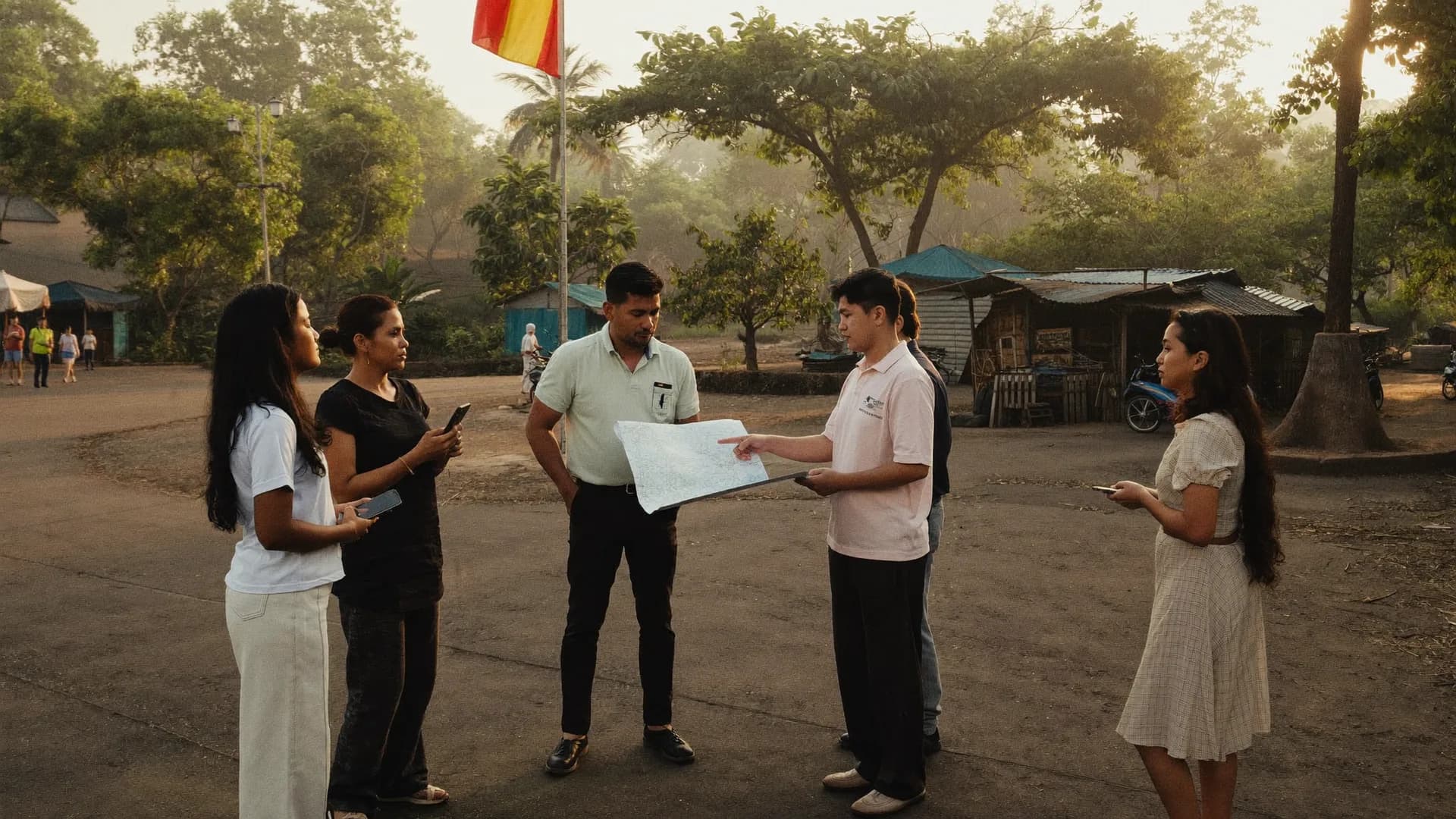
- 04
4. Collect votes privately and log refusals
The voter marks a slip or taps a private screen. Interviewers log every refusal by age band and gender so non-response can be weighted, not ignored.Polling daySurvey 3/6 · AmenitiesOfflineHow is drinking water in your area?- Comes regularly
- Comes sometimes
- Rarely / never
- Don't know
✓ Section saved on phone · autosaveBackNext - 05
5. Verify, weight and model seats
Remove records from outside the station area or with impossible timing, weight to known turnout patterns, then convert vote share to seat ranges with stated uncertainty.AnalysisLocation evidenceSurvey #BS-0412- In areaInside approx. boundary
- Accuracy±12 m
- Time09:42 · fresh fix
- Mock GPSNot detected
- Interview length11 min
Added to accepted count - 06
6. Hold release until the window closes
Nothing is published, shared or leaked until the ECI-notified prohibition period ends: half an hour after polls close in the last phase.ReleaseOutside area · 14.2 km away · in review
- Comes regularly
- Comes sometimes
- Rarely / never
- Don't know
- In areaInside approx. boundary
- Accuracy±12 m
- Time09:42 · fresh fix
- Mock GPSNot detected
- Interview length11 min
A sample of about 1,000 randomly selected voters gives roughly ±3 percentage points on a single vote share at 95% confidence. Exit polls interview voters in clusters at stations, so the effective sample is smaller. Seat projections need adequate samples in every region you model, not one large national total.
The textbook margin of error for a proportion near 50% is about 1.96 × √(0.25 / n). For 1,000 respondents that is close to 3.1 points; for 4,000 it is about 1.6 points. Those numbers assume simple random sampling. When 20 voters are interviewed at each station, voters at the same booth tend to vote alike, and the design effect can easily double the variance. A 20,000-interview exit poll spread over 1,000 stations behaves more like a far smaller random sample.
Working out sample size in five steps
Use this sequence when budgeting a state-level exit poll.
- Pick the smallest region you will report separately.
- Set the margin of error you can accept there.
- Calculate the simple random sample for that margin.
- Multiply by an assumed design effect for clustering.
- Divide by interviews per station to get stations needed.
Why seat ranges stay wide
In a first-past-the-post system, a two-point swing in a close state can move dozens of seats. Honest projections therefore publish a range and state the vote share assumptions behind it. A single seat number with no range hides the uncertainty the method actually carries.
Our view on exit poll reporting
Indian exit polls miss mainly because of who refuses to answer, which stations were sampled, how women and rural voters were reached, and how vote share was converted to seats. Close multi-cornered contests amplify each of these. Most misses trace to design shortcuts rather than to voters lying.
Sampling problems
- Stations chosen for convenience near roads and towns
- Too few stations per region, many voters per station
- Late-day voters under-covered when teams leave early
- Multi-phase elections treated as one uniform sample
Response problems
- Refusals concentrated in one voter group
- Women interviewed by men in public view
- Voters giving the socially safe answer aloud
- Interviewer standing near party workers
Modelling problems
- Vote share converted to seats with a uniform swing
- Alliance transfers assumed rather than measured
- No weighting to turnout by region
- Ranges hidden to produce a clean headline
Section 126A of the Representation of the People Act, 1951 bars conducting an exit poll and publishing or disseminating its result during the period the Election Commission of India notifies. For general elections this runs from the start of polling in the first phase until half an hour after polls close in the last phase.
Contravention is punishable with imprisonment of up to two years, a fine, or both. The ECI issues a notification for each general election and for bye-elections, so teams should read the notification for the specific election rather than rely on the dates from a previous one. The separate Section 126 silence period also restricts displaying election matter, including opinion poll results, on electronic media in the 48 hours before polling ends in a constituency.
Field conduct checklist
These practices keep a polling-day survey lawful and neutral.
- Stay outside the perimeter set by the returning officer
- No party symbols, colours or campaign material
- Anonymous forms with no names, phone numbers or EPIC numbers
- Data locked on devices until the release window ends
- Disclosure of sponsor, sample and method at publication
Not the right fit if
- Guaranteeing who will form the government
- Predicting results in very close individual seats
- Anything that needs voter names or voter-list data
- Releasing numbers before the ECI window closes
A good fit if
- An early, disclosed estimate of vote share
- Understanding which groups shifted and why
- Post-election research on issues and decision timing
- Checking pre-poll assumptions against actual votes
Exit poll survey service
Station sampling, interviewer training and GPS-verified polling-day fieldwork.
Learn moreOpinion poll survey
Pre-poll research on voter mood, issues and candidate standing.
Learn morePolitical survey solutions
Constituency research, booth-level surveys and war-room dashboards.
Learn moreSurvey cost in India
What drives the cost of field interviews and how to budget a study.
Learn moreCAPI, CATI and CAWI explained
Which data collection mode suits which election research question.
Learn moreStraight answers to the questions people ask most about this topic.
What are the exit poll rules election commission of India enforces?
Section 126A of the Representation of the People Act, 1951 bars conducting and publishing exit polls during the period the Election Commission of India notifies. Violations carry up to two years' imprisonment, a fine or both. Agencies should also follow the ECI's media guidelines on disclosure and avoid any conduct near stations that could influence voters.
When can exit polls be published: India's legal window?
Only after the notified prohibition period ends. For a multi-phase general election that is half an hour after polling closes in the final phase across all states covered by the notification. Bye-elections held on different days get their own window. Check the specific ECI notification, because dates change with every election schedule.
What limits election survey accuracy India-wide?
Accuracy depends on random selection of stations, response rates across social groups, the design effect of clustered interviews and the model that turns vote share into seats. National vote share can be close while seat counts miss badly in tight contests. Treat any published figure as an estimate with a range, not a result.
Is it legal to ask voters who they voted for?
Voting is secret and no voter is obliged to answer. A lawful exit poll asks voluntarily, lets the voter mark the choice privately, records no identity and stays outside the polling station perimeter. Results must not be released until the ECI window closes.
How many interviewers does an exit poll need?
It follows from the number of stations and interviews per station. Many designs place one or two interviewers per selected station for the full polling day so late voters are covered. A supervisor typically oversees a group of stations and checks timing, location and refusal logs as the day progresses.
Tell us the states, phases and the estimate you intend to report. We will reply with a station sample plan and field protocol.