
Most important issue
IssuesIn your view, what is the single most important problem facing people in your area today? (Open, then coded.)
For research teams, media partners and campaign analysts
This guide explains how to conduct election survey in India the way field researchers do it: define the question, draw a sample across booths, write a neutral questionnaire in the local language, interview face to face, verify every record, and report estimates with their margin of error. It also covers the Election Commission rules that limit when exit poll results can be published.
An election survey interviews a random, representative sample of adults across a constituency or state, asks a short neutral questionnaire about issues, leaders and voting intention, and weights results to the population. Its value comes from sampling and verification, not from the number of interviews alone. It measures opinion at a point in time and does not predict results.
An opinion poll is a one-time reading before polling day. A tracker repeats the same questions over weeks to see movement. An exit poll interviews people leaving polling stations on the day. Each needs a different sample and a different schedule, so decide which one you are running before you write a single question.
Section 126A of the Representation of the People Act, 1951 prohibits conducting an exit poll and publishing its result during the period the Election Commission of India notifies, which typically runs from the start of the first phase until half an hour after the last phase closes. Election Commission notifications for each election set the exact window, so read the current one.
These steps are the same whether you cover one assembly seat or a whole state. The scale changes; the discipline does not.
Hello, I am Ram Kumar. This survey is run by Sample Organisation. Purpose: to learn about amenities in your area. It is voluntary, and you can say no at any time.
Hello, I am Ram Kumar. This survey is run by Sample Organisation. Purpose: to learn about amenities in your area. It is voluntary, and you can say no at any time.
For a simple random sample, about 1,070 interviews give a margin of error near plus or minus 3 percentage points at 95% confidence for a 50% estimate. Booth clustering raises the needed number, often by 1.5 to 2 times. Every region you want to report separately needs its own adequate sample.
The usual starting formula is n = z² × p × (1 − p) ÷ e². With z = 1.96 for 95% confidence, p = 0.5 as the most cautious assumption and e = 0.03, n = 3.8416 × 0.25 ÷ 0.0009, which is about 1,067. At e = 0.05 the same formula gives about 384.
Interviews in the same booth area are more alike than interviews spread across a seat. That similarity is captured by the design effect. If you assume a design effect of 1.5, the ±3 point sample becomes roughly 1,600. More booths with fewer interviews each keeps the design effect lower than a few booths with many interviews.
A state estimate of ±3 points says nothing reliable about one district inside it. If the client wants results for each region, age band or urban and rural split, size each of those groups separately. This is the most common reason a survey budget grows after the first conversation.
Booth-level work means sampling polling station areas and interviewing households inside them. It does not mean using the voter list to find named people, and it never means tracking how individuals vote.
Draw booths with probability proportional to their electorate from the public polling station list. Inside each booth area, start at a random landmark and follow a fixed interval rule, such as every fifth house, so interviewers cannot pick friendly doors.
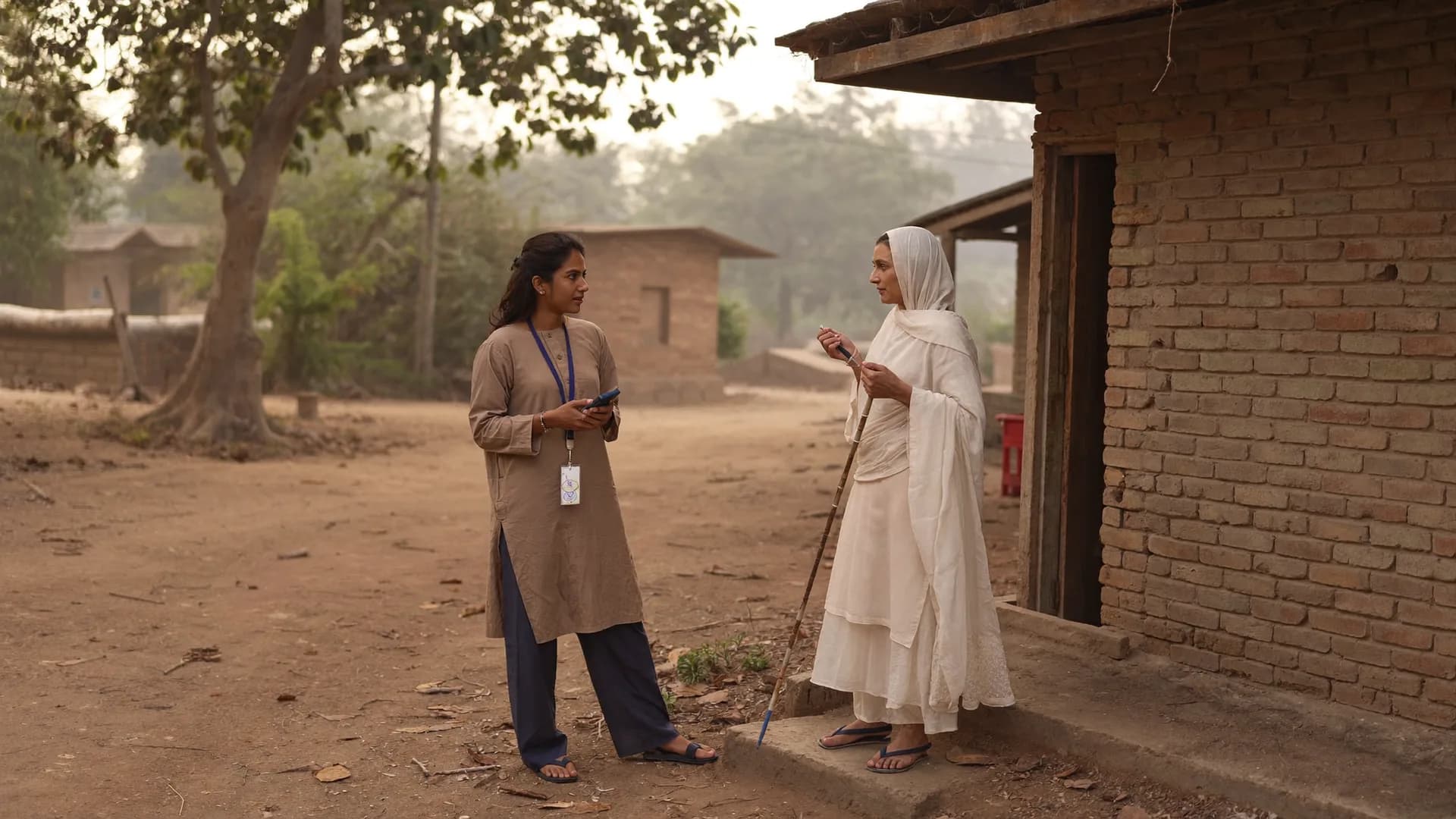
Men are more often at the door in daytime. Use a respondent selection rule within the household, and schedule evening visits so women and working adults are not under-represented. Track the gender and age mix per booth every evening.
An offline Android survey app records GPS and time for each interview even without signal and syncs later. Supervisors can see a booth's interviews on a map and query any that sit far from the assigned area.
An outline you can adapt. Keep the order: neutral questions first, voting intention later, so earlier answers do not lead later ones.
Confirm the respondent is 18 or older and lives in the area. Read a short consent statement explaining who is conducting the survey, that answers are confidential and that they may stop at any time.
Open with unprompted issues: what is the biggest problem in your area? Then rate specific services such as water, roads, power, health and jobs on a simple scale.
Satisfaction with the state and central governments and with the local representative, each asked on the same five-point scale for comparability.
Awareness of named leaders first, then favourability only among those aware. Rotate the order of names across interviews to reduce order bias.
Likelihood of voting, then intended choice, with a do not know and a refuse option. Never pressure for an answer.
Age, gender, education, occupation and household type at the end, asked in a neutral way. Community or caste questions, if included, should be optional, justified by the research purpose and handled under your data protection policy.
Examples written to be neutral. Replace placeholders with your region's issues and translate carefully.
| Mistake | What it does to results | Fix |
|---|---|---|
| Interviewing at markets and tea stalls | Over-represents men and people with free time | Household sampling with a selection rule |
| Leading question wording | Pushes answers toward one side | Neutral wording, pilot, back-translation |
| Asking voting intention first | Colours every later answer | Issues first, intention near the end |
| No location or time data | Fabricated interviews go unnoticed | GPS, timestamps and back-checks |
| Reporting sub-groups with tiny samples | Large hidden error | Size sub-groups or do not report them |
| Publishing exit poll data in the notified window | Legal violation under Section 126A | Check the ECI notification before release |
How we support opinion research and booth-level fieldwork for campaigns and researchers.
Learn moreThe same political survey solutions page in Hindi.
Learn moreSample design, fieldwork and reporting for pre-election opinion polls.
Learn moreField and methodology support for news organisations running polls.
Learn morePolling-day fieldwork planned around the Election Commission's notified restrictions.
Learn moreStraight answers to the questions people ask most about this topic.
Opinion surveys are conducted regularly in India. The main statutory restriction is Section 126A of the Representation of the People Act, 1951, which bars conducting exit polls and publishing their results during the period notified by the Election Commission. Check the current ECI notification and any Model Code of Conduct guidance before fieldwork or publication.
It depends on the margin of error you want and whether you need separate results for parts of the seat. Around 1,070 interviews give roughly ±3 points under simple random sampling, and booth clustering usually pushes that higher. Many teams accept a wider margin for a single seat and say so in the report.
No survey can promise that. A survey estimates vote intention among a sample at a specific time, with a margin of error. Turnout, late decisions and the way votes convert to seats all add uncertainty. Good reports state fieldwork dates, sample size and margin of error, and avoid seat predictions presented as certainties.
We do not import voter-roll personal data. Public polling station lists can guide which booth areas to sample, and households inside those areas are selected by a random rule. Respondents are interviewed with consent, and the survey never records how a named individual has voted.
A single-seat survey can move from questionnaire to report in a couple of weeks once the form is agreed, while a multi-district study takes longer because of translation, piloting and interviewer training. The timeline depends on geography, languages and sample size, so we set it after seeing the brief.
Share the geography, languages and the decisions the survey must inform. We will reply with a sample design note and field plan.